Research scope
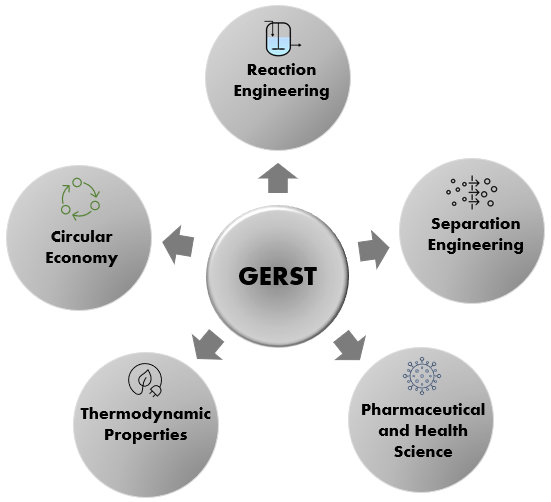
The research activities of GERST (Group on Environment, Reaction, Separation, and Thermodynamics) focus on the development of experimental and modeling work involving chemical reaction engineering and separation processes, thermodynamics and thermophysical properties, and microbiology studies. The environment is our global goal, whether through pollution prevention and control, development of sustainable technologies, recovery of by-products and residues, or addressing public health through investigation of viruses and bacteria with clinical impact.
Advanced environmental technologies are at the heart of cutting-edge research on alternative strategies to conventional treatments of wastewater, gaseous emissions, and contaminated soil remediation to reach environmental sustainability. Water reuse, value-added products extraction, solid residues valorization (biofertilizers, adsorbents, catalysts, etc.), renewable energy (biodiesel and biogas), ionic liquids development, membrane and adsorptive technologies and public health protection are inward goals lined up with ongoing projects. Also, biological and chemical emerging contaminants spread on domestic water networks is also a stringent branch of our joined research.
These objectives are tuned under a continuous debate about new circular economy and biorefinery methodologies, new concepts, and ideas aiming at the design, operation, and optimization of novel reaction systems, separation techniques, bioaugmentation methodologies, waste handling, biofuels, and ionic liquids alternatives, as well as microbiology life impact awareness, within multidisciplinary research involving chemical engineering, environmental technology, agricultural resources, and health sciences.
The GERST research covers the following major areas: