


HIPPOPOTAMUS: A LITTLE-KNOWN GIANT
World Wetlands Day has been celebrated on 2 February since 1997, aiming to raise awareness of wetland conservation and to highlight the crucial role these ecosystems play in sustaining life on our planet. Many animals depend on these habitats, including the common hippopotamus, Hippopotamus amphibius Linnaeus, 1758.
Today, the common hippopotamus, together with the pygmy hippopotamus, Choeropsis liberiensis (Morton, 1849), are the only remaining members of the family Hippopotamidae.
This large mammal is the third largest and heaviest terrestrial animal, surpassed only by elephants (Loxodonta africana (Blumenbach, 1797)) and white rhinoceroses (Ceratotherium simum (Burchell, 1817)). Semi-aquatic by nature, hippopotamuses remain in water (lakes or rivers) during the day and emerge at night to feed. They are herbivores, usually grazing on surrounding pastures rather than aquatic plants.
Hippopotamuses are a keystone species, essential for maintaining the structure and functionality of their ecosystems. They act as ecosystem engineers, influencing geomorphology, hydrology, and connectivity between aquatic and terrestrial habitats. Social and polygamous, they live in groups of around 30 individuals.
According to the International Union for Conservation of Nature (IUCN), the common hippopotamus is classified as Vulnerable (VU), and its population is declining. It is listed in Appendix II of the Convention on International Trade in Endangered Species of Wild Fauna and Flora (CITES). This decline is primarily due to habitat loss from human activity and, above all, poaching for meat and ivory from their canine teeth. Following the international ban on elephant ivory in 1989, the black market has increasingly targeted ivory from other species, including hippopotamus teeth.
These global biodiversity and sustainability issues are increasingly highlighted in museums. In the case of the hippopotamus, its reliance on aquatic habitats brings it into constant competition for water resources, often creating conflict with human populations. This is a destructive relationship for both parties, though hippopotamuses suffer the most, particularly from hunting, resulting in severe population declines in recent years. Combined with the history of extinctions, this suggests that the species could disappear in the near future, underlining the importance of museum specimens. Recently, World Hippopotamus Day was established on 15 February to raise awareness of the threats facing these animals and encourage actions to prevent their extinction.
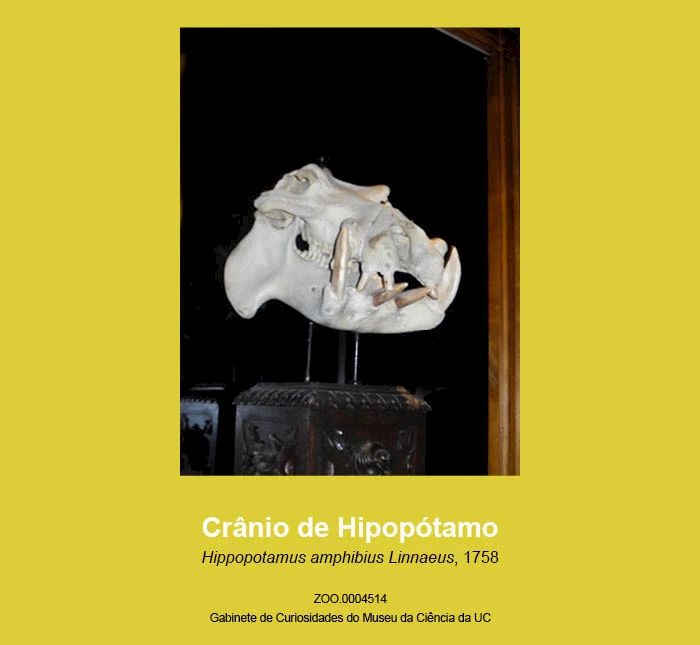
This specimen, inventory number ZOO.0004514, is a hippopotamus skull dating from the early twentieth century. No further information is associated with it. It belongs to the MCUC skeleton collection, which also includes 11 other skulls, a complete skeleton, a jaw, and several teeth.