


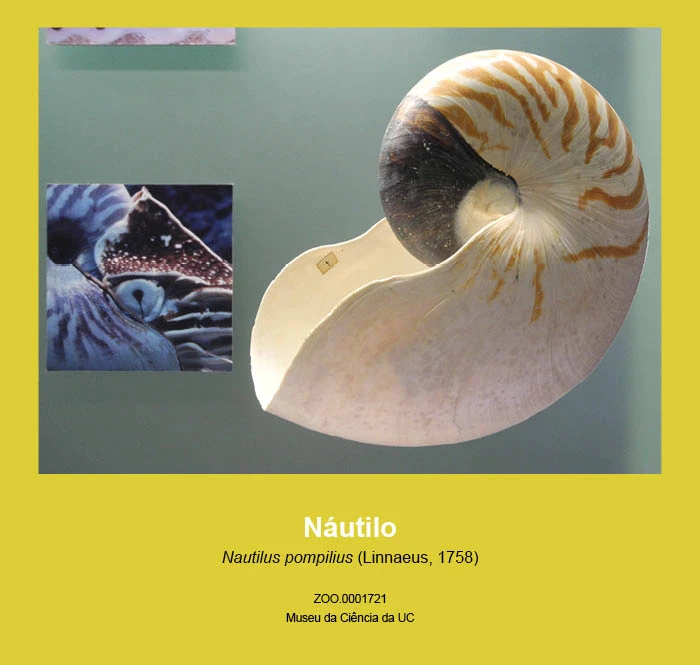
With the scientific name Nautilus pompilius (Linnaeus, 1758) — where Nautilus results from the Latinisation of the Greek nautilos (ναυτίλος), meaning "sailor", derived from naus, "ship".
This species of mollusc is characterised by its thin, smooth, spiral shell with a brown-and-white pattern.
As the animal grows, it produces up to 30 chambers inside the shell, which can reach up to 20 centimetres in chamber length, and it inhabits only the outermost chamber to move.
With very simple eyes, lacking both cornea and lens, nautiluses are found in the western Pacific Ocean, often near the seabed or coral reefs, at depths of up to 500 metres, and they move to shallower waters during the night.
This specimen, dated 1932, belongs to the Zoology collection and is on display in the permanent exhibition “Secrets of Light and Matter” at the Laboratório Chimico of the Science Museum of the University of Coimbra.