


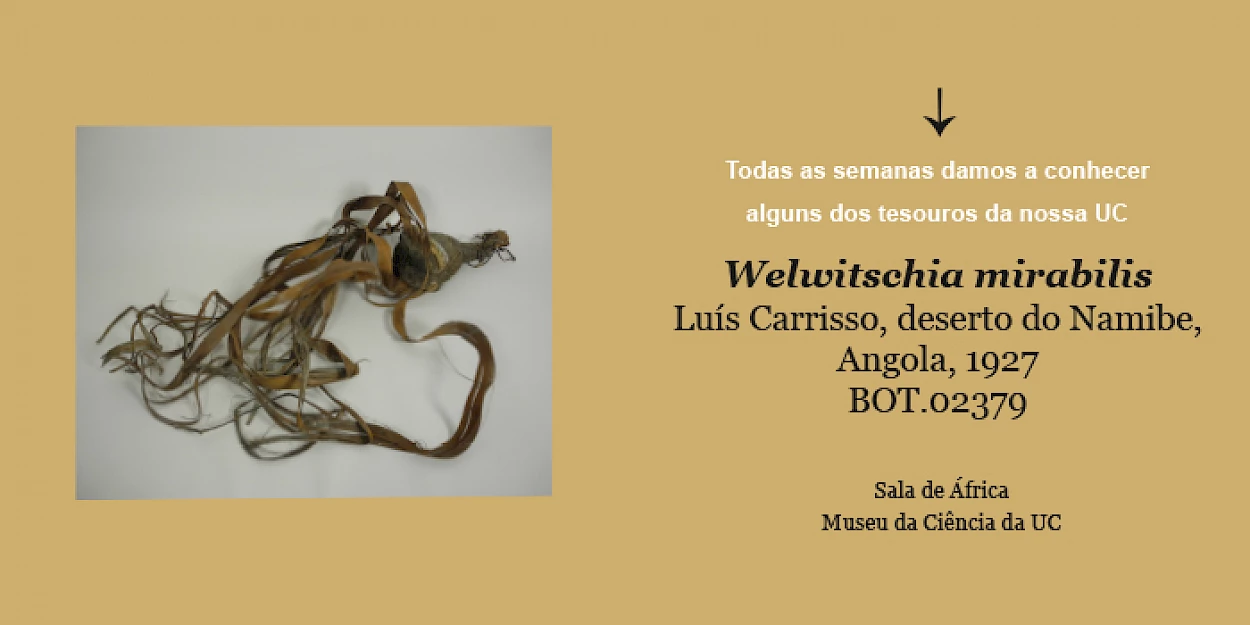
Welwitschia mirabilis, a plant with unusual characteristics and a contemporary of the dinosaurs, is a botanical relic from the Jurassic period. It is found only in the Namibe/Moçâmedes Desert, spanning the coastal regions of Namibia and Angola. Considered a botanical icon, it belongs to the gymnosperms (cone-bearing plants).
A dioecious plant (with male and female individuals), perennial and woody, it grows very slowly, with a main root, a very short stem, and only two leaves. These opposite, dark-green leaves grow continuously and, when mature, are torn by the wind, giving the plant the appearance of a giant octopus immobilised in the sand.
It was discovered by the Austrian botanist and physician Friedrich Martin Josef Welwitsch (1806–1872) on 3 September 1859, near Cabo Negro (south-western Angola), during flora and fauna explorations (1853–1861) under Portuguese sponsorship.
Specimen BOT.02379 was collected in the Namibe/Moçâmedes Desert during botanical expeditions to Angola (https://www.uc.pt/en/herbario_digital/history/Carrisso) led by Luís Wittnich Carrisso (1886–1937). Professor of Botany at the University of Coimbra, Carrisso brought this specimen and many others, including much larger ones, to the University, where they are now housed in the UC Science Museum. He died on 14 June 1937, in the Moçâmedes Desert, during what would be his third and final expedition.