



Sustainable Mobility
University of Coimbra’s Commitment
The University of Coimbra (UC) regularly assesses the travel patterns of its academic community and has incorporated specific objectives to promote more sustainable travel into its Sustainability and Social Responsibility Plan 2023–2027.
The transition to more sustainable modes of transport not only helps to reduce greenhouse gas emissions but also improves the quality of life for the academic community. Thus, the creation of incentives for sustainable mobility forms part of one of the Strategic Guidelines on the environment and climate action, which sets out a strategy for environmental and energy sustainability on the campuses of the University of Coimbra.
Measurement of commuting patterns
The University conducts institutional mobility surveys to identify the main modes of transport used by students, staff and employees, as well as the associated environmental impacts.
The questionnaire collects detailed information on journeys made on foot, by bicycle, by public transport, by car and by other means of transport.
Institutional mobility questionnaire [Portuguese content only]
Targets to promote sustainable mobility
The PSRSUC sets out specific objectives for:
-
encourage active travel by improving conditions for walking and cycling;
-
promote low-impact modes of transport, such as public transport and electric vehicles;
-
reduce the environmental impact of commuting, aligning mobility with climate mitigation targets;
These goals frame the actions currently underway and guide the future development of sustainable mobility initiatives.

Total carbon footprint (ton CO2,E).
Source: UC Management and Accounts Report 2024 [Portuguese content only]
Ongoing actions and initiatives
The University of Coimbra iimplements a range of measures to promote sustainable mobility, including the expansion of active mobility infrastructure, institutional partnerships and awareness-raising initiatives on low-impact transport options.
Active mobility
-
Bicycle parking spaces at the University of Coimbra’s multiple campuses
-
Encouraging the use of bicycles and scooters as a healthy, low-impact alternative
Ucicletas

A project for the temporary loan and use of UC bicycles, open to the entire academic community, including teaching staff, support staff, researchers and students. The UCicletas initiative aims to promote physical activity and sporting habits within the UC academic community by encouraging the use of alternative modes of transport to public transport and private vehicles, as well as fostering attitudes and behaviours that contribute to achieving sustainable development goals through physical activity and sport. In 2024, 28 bicycles were made available, 20 of which are electric, and bicycle parking spaces have also been provided on campus. Find out more about how to take part here.
Public Transport - Ecovia Park & Ride UC
The Ecovia Park & Ride system is a public transport service launched on 1 June 2021 by Coimbra City Council (CMC), featuring special routes connecting to the city’s main central locations via electric minibuses. The University of Coimbra (UC), recognising that this system helps alleviate parking pressure in the areas where its buildings are located and addressing environmental sustainability concerns, has entered into an agreement with the CMC with the aim of securing attractive access conditions for the entire UC community, thereby improving mobility.
In the last few years, this partnership has made it possible to obtain the General Network Pass - Passe Rede Geral + [Entidade - UC] -, currently priced at €25/month. UC has subsidised 50% of the cost of this pass, bringing the final price to €12.50/month.
All users of the Polo I car parks who have an allocated space and choose not to use it, or those who, having applied for a parking space, have not been allocated one for the academic year in question, are eligible to join this initiative.
Applications to join the UC Ecovia Park & Ride system open annually, prior to the start of the academic year, with all members of the UC community being notified by email of the application period and the conditions of membership.
The Facilities and Assets Management Service (Serviço de Gestão das Instalações e Património - SGIP) is responsible for the internal operation of the partnership. Should you have any queries, please contact them preferably by email at estacionamento@uc.pt. For enquiries regarding timetables and transport services, please contact SMTUC – Coimbra Urban Transport.

Electric mobility
The University provides charging points for electric vehicles. There are electric vehicle charging points in six buildings at FCTUC (Campus II), in the Faculty of Medicine and Rectorate building (Campus I) and at the Faculty of Pharmacy (Campus III), with a total of 26 charging points, representing a 63% increase compared to the previous year. In addition, there are two further stations with a total of eight charging points on public roads at Campuses I and II, which are managed externally to the UC, bringing the total to 34 charging points across the campuses. These figures relate to 2024 and are updated annually in the UC Sustainability Report.
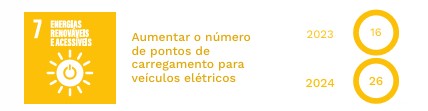
The number of charging points for electric vehicles rose from 16 in 2023 to 26 in 2024.
Source: 2024 Sustainability Report
Commuting
The UC+VIDA project website outlines the solutions and measures available to facilitate and promote sustainable travel to the workplace.
Please use the form available on the project website to share your suggestions or ideas on how to improve travel at UC, as well as other aspects that contribute to your well-being and the balance between your professional, personal and family life.
Visit the website here.
Pedestrian Priority and Accessibility on Campus
Urban Rehabilitation Area (ARU) Universidade/Sereia
The University of Coimbra played an active role in the public presentation of the preliminary study for the University/Sereia Urban Regeneration Area (ARU) – Urban Redevelopment of the Alta Universitária – Praça João Paulo II – Sereia axis, held on 9 April 2024, reinforcing its commitment to pedestrian mobility on its campuses.
The project, developed by Coimbra City Council, aims to transform UC’s Campus I into a primarily pedestrian area, prioritising walking over motor vehicle traffic.
The main measures prioritising pedestrian mobility include:
- Full pedestrianisation of Rua Larga, with more trees and street furniture;
- A significant widening of the pavements on Calçada Martim de Freitas;
- The creation of a cycle path linking Alta to Jardim da Sereia, which may in future be extended to Celas;
- Priority for pedestrian crossings at the Rotunda do Papa (Praça João Paulo II);
- Creation of urban leisure spaces in Largo da Porta Férrea;
- Drastic reduction in car parking (removal of 30 spaces in Largo da Porta Férrea and in the central area of Largo D. Dinis);
- Restriction of vehicle access to Alta Universitária.
Read the full article here.
The Botanical Garden Woodland
The Botanical Garden Woodland at the University of Coimbra is an important green space covering more than 9 hectares that links the lower and upper parts of Coimbra, encouraging walking in a natural environment within the university campus.
This footpath, open to the public, allows for walking in a natural setting, surrounded by centuries-old trees, wild vegetation and a bamboo grove. The Wood also features built heritage, such as the Cold Greenhouse, the Chapel of São Bento and the Three Spouts Fountain.
With the opening of the Wood, the Lower and Upper parts of the city of Coimbra are now linked not only by a dedicated footpath, but also by the ‘Linha do Botânico’, served by a hybrid bus that runs the uphill route between the gate on Rua da Alegria and the gate on Rua do Arco da Traição.
The area has been redeveloped through a partnership between the University of Coimbra and Coimbra City Council, funded by QREN/+Centro, reinforcing the University’s commitment to creating attractive and sustainable pedestrian routes that encourage the academic community to walk.
Read the news about the reopening of the Mata here.


© UC | Paulo Amaral
Notable Projects
3Cs - Cycling, Campus & City

This project, which focuses on sustainability, aims to highlight the value of sport and environmentally friendly mobility, emphasising the need to use active transport to reduce carbon emissions. The main objective is to promote the use of bicycles, whether electric or conventional, for travel within and outside cities.
With eco-friendly mobility as its main focus, the initiative centres on studying habits and behaviours and identifying ideal routes to support all stakeholders. Based on these studies, a handbook will be created to guide future participants.
The project’s website also features educational content on:
- Cycling in urban and non-urban areas
- 5 steps to cycling
- The ABC quick check
- Tips for sustainable travel
- Active mobility and health benefits
- Cycling mobility
For more information on the 3Cs Project – Cycling, Campus & City, visit the website here.
CHALLENGE MUV GAME FROM THE EUROPEAN 3CS PROJECT
As part of the European 3Cs (Cycling Campus & City) project, UC is challenging the university community to adopt more active and sustainable ways of getting around using the MUV Game app.
The app monitors CO2 emissions and tracks sustainable journeys, awarding points to users who opt for more environmentally friendly transport.
In 2024, the challenge ran for four weeks, with prizes for the top performers, including Decathlon vouchers, free use of bicycles and sports equipment.
With the support of the UC Office for Sustainable Development, the initiative aims to promote active lifestyles and reduce CO2 emissions, prioritising travel on foot, by bicycle and by public transport.
For more information about the MUV Game app, visit the website here.
GREENBEAR - HUMAN-CENTERED EDGE ARTIFICIAL INTELLIGENCE FOR SUSTAINABLE CITIES
GreenBear is an innovative research project that combines Artificial Intelligence, the Internet of Things (IoT) and mobile apps to promote eco-friendly behaviour in urban environments through gamification.
Developed in partnership with Coimbra City Council and funded by the Foundation for Science and Technology, the project uses a platform that encourages sustainable behaviours such as using public transport, recycling and making use of green spaces. Users are motivated through a rewards system, which includes tickets to cultural events and discounts on public transport.
The Human-in-the-Loop (HiL) concept is central to GreenBear, enabling the integration of devices, digital platforms and human interaction within an ecosystem that promotes sustainability and environmental awareness.
For more information on the GreenBear Project, visit the website here.