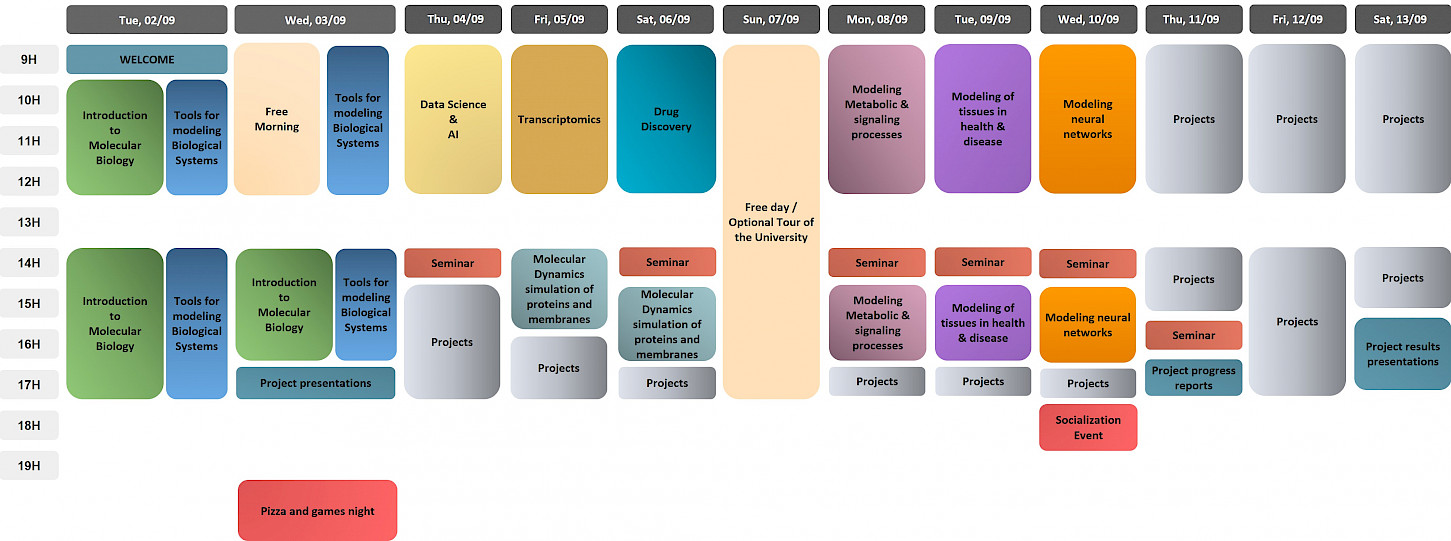
Key dates:
Application deadline: May 20, 2025
Acceptance announcement: May 31
Registration/payment deadline: June 15
Registration confirmation announcement: June 30
Lecturers and tutors
- Conceição Egas* (Center for Neuroscience and Cell Biology, University of Coimbra and Genoinseq)
- Armindo Salvador* (Center for Neuroscience and Cell Biology and Coimbra Chemistry Center, University of Coimbra)
- Rui Travasso* (CFisUC, Physics Department, University of Coimbra)
- Tiago Pereira* (CISUC, Informatics Engineering Department, University of Coimbra)
- Joel Arrais (CISUC, Informatics Engineering Department, University of Coimbra)
- Pascoal Silva (Instituto Superior de Engenharia de Coimbra)
- Ângelo Figueiredo (Coimbra Chemistry Centre, University of Coimbra)
- Luana Afonso (Center for Neuroscience and Cell Biology, University of Coimbra)
- Adérito Araújo (CMUC, Mathematics Department, University of Coimbra)
- Tiago Azevedo (CFisUC, Physics Department, University of Coimbra)
- João Carvalho (CFisUC, Physics Department, University of Coimbra)
- Ana Luísa Carvalho (Center for Neuroscience and Cell Biology, University of Coimbra)
- Francisco Fernandes (PurrAI)
- Renato Duarte (Center for Neuroscience and Cell Biology, University of Coimbra)
- José Augusto Ferreira (CMUC, Mathematics Department, University of Coimbra)
- Luís Loura (Coimbra Chemistry Center, and Faculty of Pharmacy, University of Coimbra)
- Manuel Nuno Melo (ITQB NOVA, NOVA University of Lisbon)
- Raquel Gouveia (Center for Neuroscience and Cell Biology, University of Coimbra)
- Irina Moreira (Center for Neuroscience and Cell Biology, University of Coimbra)
- Paulo Oliveira (Center for Neuroscience and Cell Biology, University of Coimbra)
- Urzula Orzel (Center for Neuroscience and Cell Biology, University of Coimbra)
- Matilde Sá (CFisUC, Physics Department, University of Coimbra)
*coordinators
Application and registration
There is a limited number of places available!
Please use this form to apply no later than May 20.
Registration fee: 120€, to be paid upon acceptance and registration.
Registration fee covers course materials, coffee-breaks and lunches at the University canteens for 8 days.
Cancellation policy:
Until July 6: 80% refund (20% taken for administrative expenses)
From July 7 to August 27: 50% refund
August 28: no refund
All bank expenses in the registration fee payment and eventual refund must be paid by the registrant.
The organization has negotiated affordable accommodation in local hostels (from ~269€ for the whole duration of the course for accommodation in bunk beds, shared bathroom) for accepted participants in the Summer School. Further information will be provided upon registration.
Invited Speakers
Computational Chemist specialising in the application of computational approaches to address complex challenges in drug discovery. Currently a Research Leader at Isomorphic Labs (London, UK), I previously held positions as Senior Computational Drug Designer at Exscientia (Oxford, UK) and Modeller/Computational Chemist at BSIM Therapeutics (Coimbra, Portugal). My background includes a PhD in Computational Biophysics from the University of Dundee (UK), focusing on proton translocation and energy coupling in cytochrome cbb3 oxidase and mechanisms of Parkin activation. Earlier research experience was gained as a Research Student at the Molecular Simulation Laboratory, ITQB NOVA, Portugal, where I focused on the role of protonation/conformation coupling events in biological systems. I hold a BSc and MSc degrees in Biochemistry from Faculdade de Ciências, Universidade de Lisboa.
I am a computational neuroscientist with a strong interest in human cognition, in particular working memory and decision-making and how these are affected in pathological conditions.
My research approach reflects the breadth of my academic background, which spans computer science, biology and machine learning. In my research, I use biophysical and deep learning models to guide the analyses of large scale recordings, as well as the design of novel experiments in humans.
My current research goal is to help unveil the cross-region interactions within the primate brain that support cognitive flexibility, and to determine whether their disruption underlies the cognitive inflexibility observed in clinical populations, such as those with schizophrenia. This research will be conducted at the newly established Institute for Neuromodulation (INM), which was created through a close collaboration between Sainte-Anne Hospital and Neurospin, in Paris.
At INM, we record and manipulate the human brain at all scales with non invasive methods (ultra high field MRI, M/EEG), invasive electrophysiology (sEEG, tracking of monoamine release with voltammetry) as well as casual interventions (deep brain stimulation, pharmacology, vagus nerve stimulation, focused ultrasound stimulation and TMS).
Associate Professor at the University of Cyprus (UCY), an Honorary Senior Lecturer at UCL and Technical Chair of the BioDynaMo consortium. Since 2019 he established at UCY the In Silico Modelling group (https://in-silico-modelling.ucy.ac.cy). His expertise is in biomechanics, computational mechanics, numerical methods, in silico modelling and model-to-imaging data integration. Dr Vavourakis has been a Marie Curie Fellow, he has taken leading role in the in silico modelling efforts in FP7, H2020-HPC and EPSRC projects, while he coordinates an EIC Pathfinder Open and a Cyprus Cancer Research Institute project, and is a team member of an EIC, one RIF project and 2 COST Actions.
Rui Alves is a Full Professor of Bioinformatics and Computational Systems and Synthetic Biology at the University of Lleida (UdL), holding a Ph.D. in Theoretical Biochemistry from the University of Michigan/University of Lisbon (2000). Following postdoctoral research in London and California, he joined UdL as a Ramon y Cajal Researcher, eventually becoming Associate Professor and later Full Professor. He held several leadership roles, including Director of UdL’s Ph.D. Program in Health, local director of the Catalan Interuniversity Ph.D. Program in Bioinformatics and the Master in Biomedical Data Science, and currently Vice-Chair of the Ciències Mèdiques Bàsiques department. His research focuses on molecular circuit design, synthetic biology in yeasts and cereals, and big data tools for health and agriculture. His work has to the development of several plant and microbe-based applications, such as drought- and parasite-resistant maize, and to contributions to the Earth Biogenome Project. He authored over 70 research papers, led or contributed to over 20 research projects and developed more than 10 open-source software tools. He currently serves on editorial boards of Scientific Reports and Frontiers in Genetics, reviewing over ten papers annually.
In this talk we will present some mathematical models for mosquito and pest populations and present some results concerning their dynamics and optimal and feedback control strategies. We will mostly concentrate on models for the Sterile Insect Technique (SIT) but also briefly mention the Wolbachia population replacement strategy for mosquitoes. We will consider both Ordinary Differential Equation models and spatial models described by systems of reaction-diffusion Partial Differential Equations (PDE).
Programme