


About PERSIST
PERSIST aims to achieve a better understanding of how socio-economic, socio-cultural, and socio-political factors shape PEDs (Positive Energy Districts) and their interrelations with technological, regulatory, and investment aspects across different geographical, cultural, and economic contexts. The project investigates the relevant conditions for PEDs across Europe and identifies the most relevant participation archetypes to develop decarbonization scenarios for an optimized flexible and participative Energy System, in an Urban Living Lab (ULL) setting. PERSIT benefits from a strong network of urban living labs (or specific pilot projects of PEDs) that represent different social practices and regulatory contexts within Europe. We expect to observe different cognitive norms (e.g., social aspirations, expected conform levels, environmental concerns), different energy practices or regulations (e.g., available technology and resources, marketing practices and stakeholders, price structures).
The project investigates the relevant conditions for Positive Energy Districts (PEDs) across Europe and identifies the most relevant participation archetypes to develop decarbonization scenarios for an optimized flexible and participative Energy System.
The project:
-
analyses processes which are internal to relevant social groups with a focus on empowerment and activation of citizens not yet engaged including the impact of digitization of the energy system and the proliferation of social media.
-
assesses existing / emerging participation models for renewables (in electricity, heating & cooling, energy efficiency and flexibility) with regard to approach, offer and take-up; external environmental (e.g., openness of institutional or corporate environments, availability of sympathetic interlocutors, access to financial or other sources of support, legal or other obstacles), and internal variables describing the social groups and other demographic variables.
-
accelerates decarbonization strategies, through local energy management and promotion of local distributed energy resources (DERs) in PEDs.
-
improves assets energy efficiency and cost-efficiency and tests new business models for PEDs.
-
formulates concrete policy recommendations to public authorities at regional, national and supranational level considering the diversity of legal systems and geographies on the basis of decarbonization scenarios for the energy system.
PERSIST will co-create, test, validate, and scale up a portfolio of interventions for user empowered, decarbonized and resource efficient PEDs around Europe. We will achieve it through inter- and trans-disciplinary applied research and development at the interface of markets, technology, policies and society. In the framework of «Urban Living Labs», new scientific approaches, concepts, and technologies are to be implemented, tested, and evaluated in demonstrators. The human being as an individual, but also as part of social groups and the energy system, is the key element for achieving efficiency goals and as such in the center of the living labs, which are implemented as “public-private-people” partnership.
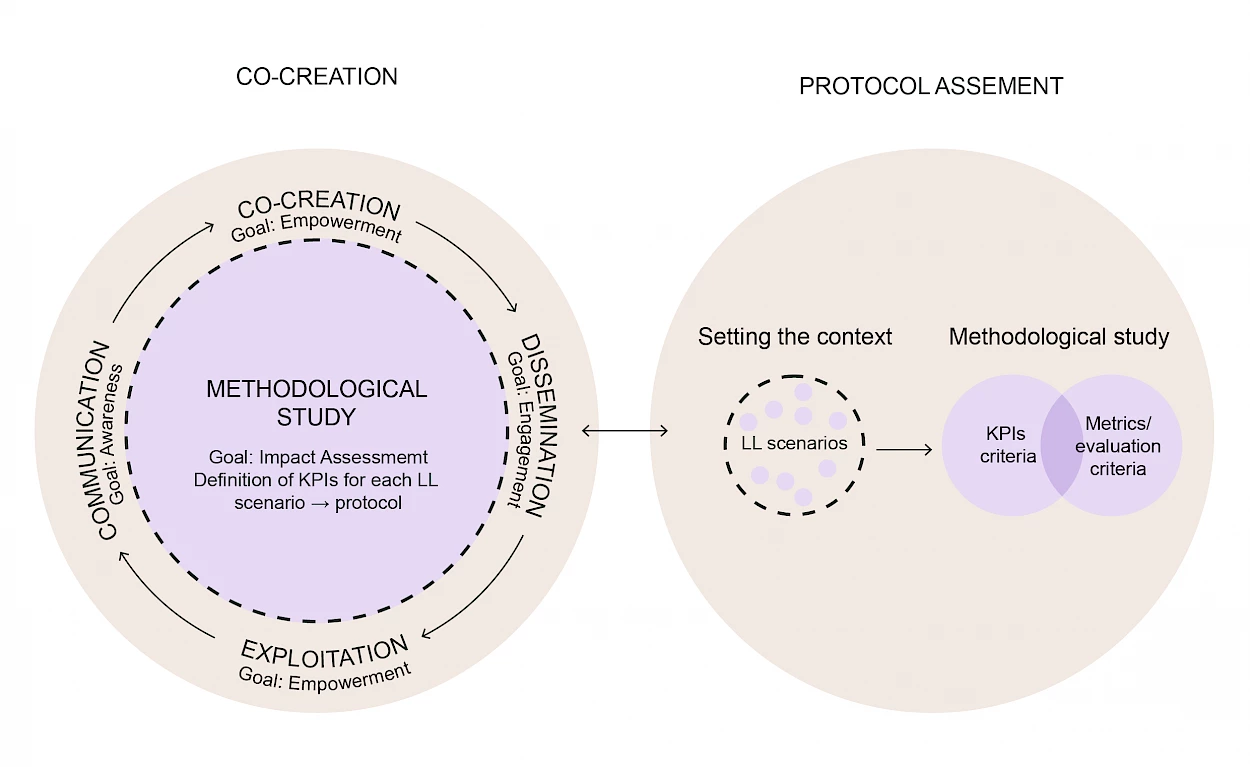
Overall strategy of the work plan
The complex research objectives of PERSIST forbid a simple ‘one-research-method-fits-all’ approach to yield accurate and replicable results. Therefore, we pursue a mixed-methods technique, i.e., combining qualitative and quantitative research methodologies and across various disciplines. In recent years there has been an increasing consensus that, when tackling complex multi-layered problem settings, mixed methods research yields sounder and more cohesive results. Moreover, there is evidence that especially if research is to produce results with practical implications – a core aim of PERSIST – the mixed methods technique is more reliable in terms of pragmatic success and replicability. The PERSIST consortium involves multiple living labs and pilots in different countries, increasing the possibilities of multiplication and scaling up of solutions. LLs will be used to co-create, test and evaluate the impact of the changes on technical artefacts, social practices, rules and regulations. The PERSIST concept is based on four interrelated main research work packages (WPs) that build on one another; they are connected to one integrated impact assessment, namely WP5 and are framed by two general WPs, namely WP1 Project Management and WP7 Dissemination.

Work Packages
