


Brain-on-PCB: Multilayer Printed Circuit Boards for 3D brain modelling
KEYWORDS: Bioelectronics; Cell-cell signalling; Electrophysiology; MEA; Microelectrode arrays.
Human behavior, memories, emotions, learning abilities, cognitive dysfunction, and various forms of dementia hinge significantly on communication pathways within the brain, where cell-cell signaling plays a pivotal role in both normal physiology and disease pathogenesis.
In response to the ongoing challenge of measuring the electrical activity of distinct cell populations in separate brain regions, we have designed and tested two versions of a multilayer printed circuit board (PCB) integrated with microelectrode arrays (MEAs).
This innovative PCB, featuring conducting holes that goes through two or more adjacent layers and electrode structures, allows the measurement of signals between cell groups in different layers. Each layer, representing a distinct brain region with specific cell types, communicates with adjacent layers via conductive holes. Incorporating microfluidics into the PCB enhances its utility for functional drug screening, ultimately reducing animal usage and improving patient outcomes through more effective screening methodologies.
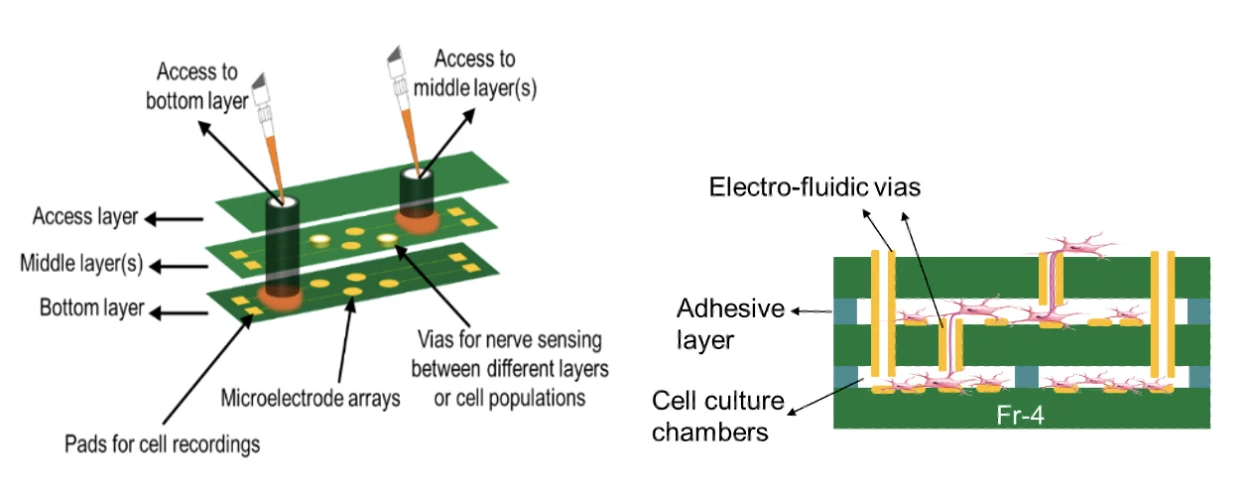
A. A schematical view of the MEA
Advantages |
|
Uses cells derived from living patients, coupled in a bidirectional 3D structure, as in the case of a human brain. |
| It allows readouts and electrical intervention in cells at the interception points of two or more cell populations. |
| Locally (up to a single nerve resolution) and non-invasively study the interaction of specific brain regions. |
| More affordable. |
| More precise. |
| Accurately translate communication between cells/nerves/tissues to readable and comprehensive language. |
Applications |
| Healthcare diagnostics: to identify novel targets for treatment of cognitive dysfunctions and/or neurological/psychiatric disorders. |
| A better and unprecedented understanding of brain circuits. |
STAGE OF DEVELOPMENT: TRL 3
IPR LEGAL STATUS: EP4256328 and US20240026276
OWNERSHIP: The rights to the technology are held by the University of Coimbra.
COLLABORATION SOUGHT: Licensing for further developments or R&D partnership.