Facilities
Transient Absorption & Photoacoustics
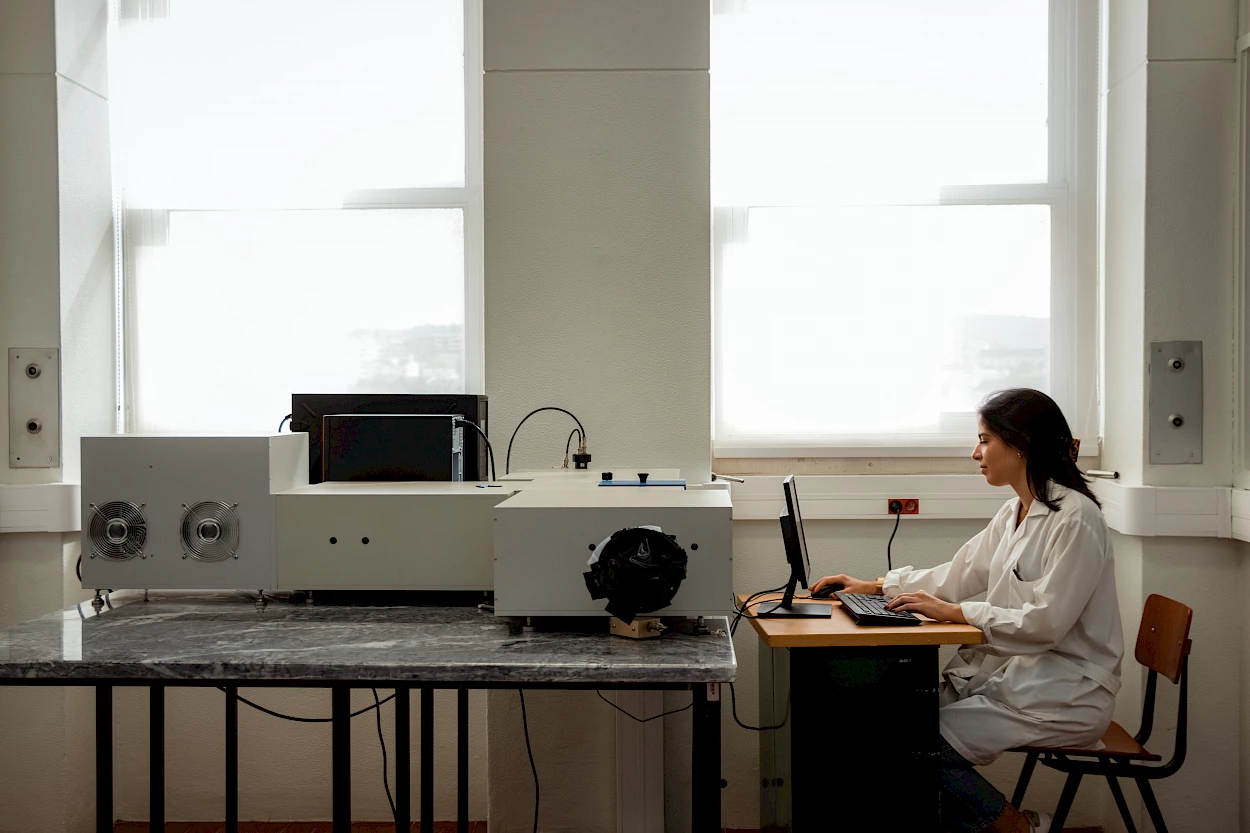
The Laboratory for Transient Absorption and Photoacoustics is located in the 2nd floor (E floor) of the building of the Department of Chemistry of the Faculty for Sciences and Technology of the University of Coimbra. The laser laboratories are dedicated to transient absorption spectroscopy and photoacoustic calorimetry. The laboratory has four main working stations and is linked to auxiliary preparative laboratories, cell culture laboratory and office space. Two of the main working stations are dedicated to Photoacoustics and the other two to Transient absorption. The Photoacoustic working stations comprises instrumentation for ms/ns/ps time resolved Photoacoustic Calorimetry and Photoaocustic Tomography. For Transient absorption the laboratory has ns laser flash photolysis and fs pump-probe spectroscopy set-ups. The laboratory is equipped with pipes for handling laboratory gases and accessories for working at distinct temperatures and deal with solid and liquid samples. Singlet oxygen detection is also possible in the Laboratory. A fifth working station, in a separated room, is dedicated to the preparation and characterization of solar cells. The laboratories are acclimatized and are located close to each other as well as to the work offices of the research team members.
The following specific main equipment is available in the LPR:
-
Home-made time-resolved photoacoustic calorimetry flow cells, includes temperature controlled cells and automatic injection models (SSI model 300 LC pump; Kloehn syringe pump).
-
Panametrics/Olympus 0.5, 2.25, 10, 50, 100, 225 MHz transducers and 20 MHz hydrophone for photoacoustic detection.
-
Available pulsed excitation sources for photoacoustic: PTI PL 2300 nitrogen laser and PTI PL 202 dye laser; Spectra Physics Quanta-Ray ns Nd:YAG laser; EKSPLA 2143A ps Nd:YAG laser; EKSPLA NL301G ns Nd:YAG laser; EKSPLA OPO model PG-122; Quantel Big Sky Ultra 50 Nd:YAG laser attached to a second harmonic generator.
-
Digital oscilloscopes: Tektronix DSA 601, Tektronix TDS 3000D and Tektronix DPO 7254.
-
Flash photolysis Applied Photophysics LKS.60 (includes the Nd-Yag/1.5J/8ns laser Spectra Physics Quanta-Ray model second, third and fourth harmonic generator and Tektronix TDS 3000D oscilloscope). Singlet Oxygen Detection with cooled Photomultiplier Tube IR Hamamatsu R5509-42, 600 lines gratting.
-
Excitation and analyzing sources available for Flash photolysis: PTI PL 2300 nitrogen laser and PTI PL 202 dye laser; Spectra Physics Quanta-Ray ns Nd:YAG laser; EKSPLA 2143A ps Nd:YAG laser; EKSPLA NL301G ns Nd:YAG laser; EKSPLA OPO model PG-122; Quantel Big Sky Ultra 50 Nd:YAG laser attached to a second harmonic generator, Lynx Tec 500 diode laser 633 nm, 649 nm, 748 nm (10-40 mW) , Custum made Hamamatsu diode lasers 748 nm (100 mW).
-
Helios broadband pump-probe femtosecond transient absorption spectrometer: includes an Ultrafast Amplifier System Solestice from Spectra-Physics comprising a regenerative amplifier, a stretcher/compressor and seed (mode locked Ti:sapphire Mai Tai) and pump (Nd:YLF Empower) lasers. The resulting 110 fs, 795 nm output is used for excitation (pump) with the use of a Light Convertion TOPAS Prime OPO for obtaining the desired wavelength. A fraction of the 795 nm beam is used to create a white UV, Vis or NIR light continuum (probe). The instrument response function for the pump-probe experiments is about 150 fs.
Cryo & Bio Spectroscopy
The Laboratory for Molecular Cryospectroscopy and Biospectroscopy is located in the 2nd floor (E floor) of the building of the Department of Chemistry of the Faculty for Sciences and Technology of the University of Coimbra. The laboratory has three main laboratorial spaces, linked to auxiliary preparative laboratories, the lasers’ room, the air treatment station and offices. Two of the main laboratories are dedicated to IR spectroscopy and the third to Raman spectroscopy. All these laboratories are equipped with facilities for working at cryogenic temperatures, vacuum systems and pipes for handling laboratory gases. The laboratories are acclimatized and stay close to each other as well as to the work offices of the research team members. The Laboratory computer centre is also located in the vicinity of the laboratories.
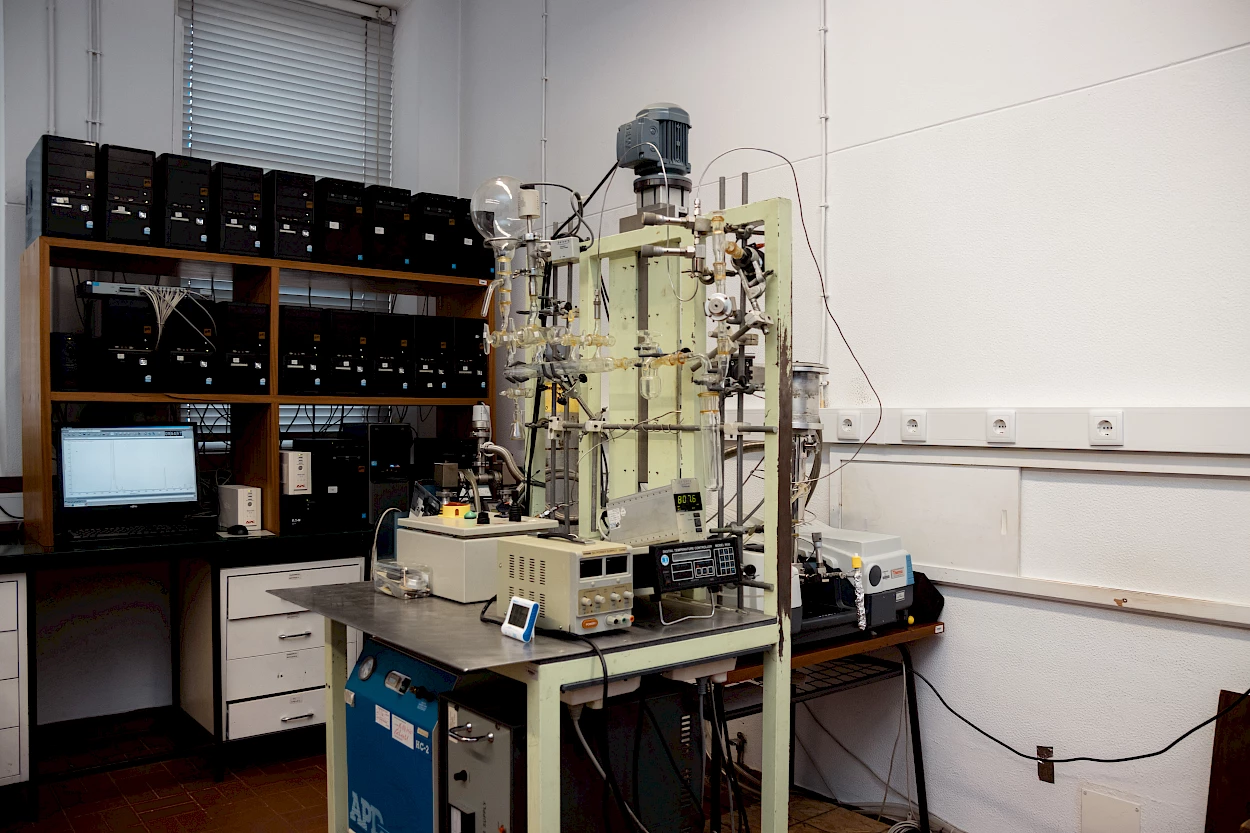
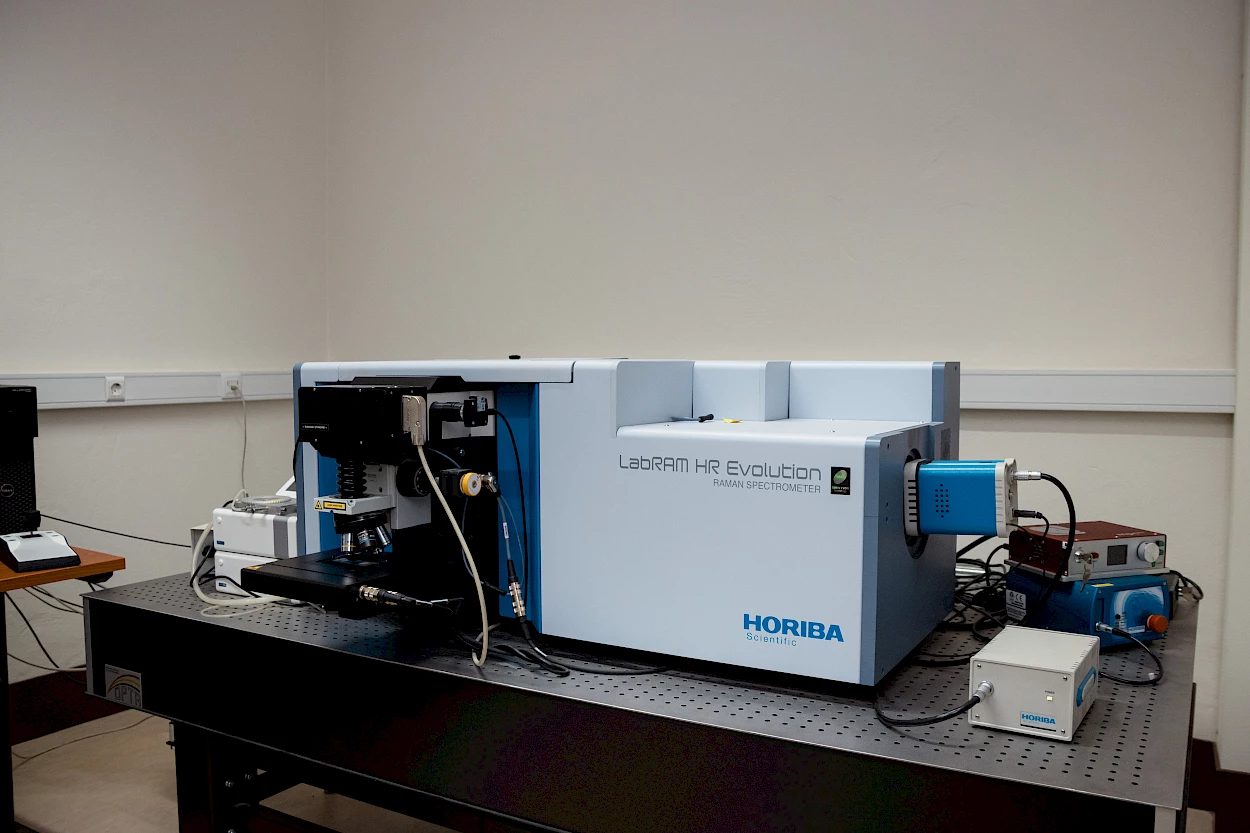
The following specific main equipment is available in the LMCB:
- Nd-YAG Quanta-Ray PRO-230-10 Laser with BeamLok-355 and EEO-355 Enhanced Energy Options and second and third harmonic generators
- Spectra-Physics MOPO SL, with FDO-970, IEEE-488 and MAP-SL options (bandwidth 0.2 cm-1, 220-1800 nm)
- Continuous wave diode laser Toptica DLC TA PRO (fwhm of 1 MHz, up to 3 W, 950-990 nm)
- Ar+ continuous Laser (Spectra Physics; air cooled)
- 150 W Xe-Arc light source with 150 mm focal length monochromator (MLS-150-150, LOT-QuantumDesign)
- Two closed-cycle helium cryostats (APD Cryogenics HC-2 compressor with a DE-202A expander) capable of providing temperatures of 10 K
- Two closed-cycle helium cryostats (Advanced Research Systems and Sumitomo) capable of providing temperatures of 4 K
- Variable temperature infrared/Raman/DTA cell (Mettler-Toledo FP900, with FP90 central processor)
- Infrared mapping/imaging: Nicolet system (iN10 MX), with 10 μm spatial resolution (3 μm in ATR mode)
- Three mid-IR near-IR FTIR Spectrometers - Nicolet 6700
- Mid-IR near-IR FTIR Spectrometer - Nicolet iS50
- Mid-IR FTIR Spectrometer - ATI Infinity Series
- Raman mapping/imaging: Confocal microspectrometer LabRam HR Evolution (Horiba Scientific).
- Raman spectrometer (Nicolet DXR SmartRaman), with commutable excitation lasers in the visible and IR range
- Portable Raman Spectrometer - BWTek i-Raman Pro
- UV/Visible spectrometer (ScanSci)
Fluorescence
The following specific main equipments are available:
- Two fluorescence spectrophotometers (Horiba-Jobin-Yvon FL322 and Fluoromax 4) and phosphorimeter. Also available are numerous accessories such as specific cuvettes and integrating sphere for solid state fluorescence quantum yield determinations.
- Nanosecond time correlated single photon counting (with ca. 150 ps time resolution) with nanoLEDs (282 nm, 311 nm, 339 nm, 373 and 460 nm) as excitation source.
- Picosecond time correlated single photon counting (with ca. 3 ps time resolution). The excitation source consist of a picosecond mode-locked Ti:Sapphire Laser (Tsunami, Spectra Physics) pumped by a diode-pump YAG Laser (Millenia Pro- 10 s, Spectra Physics). Available excitation windows: 240-310 nm and 360- 470 nm). Alternatively, a PicoQuant picoled model LDH-P-C-450B with λexc= 451 nm can be used as excitation source. The detection system of the ps-TCSPC equipment includes a Hamamatsu microchannel plate photomultiplier (R3809U-50) with emission wavelength range from ~290 to 850 nm.
- Polarizers for fluorescence anisotropy (steady-state and time-resolved) studies are also available.
- Access to controlled low temperature experiments (from 300 K to 77 K) including absorption and fluorescence (steady-state and time-resolved), laser flash photolysis through an Oxford Instruments Optistat DN2 cryostat.
- HPLC-DAD
- Spin-coating and associated film making facilities.
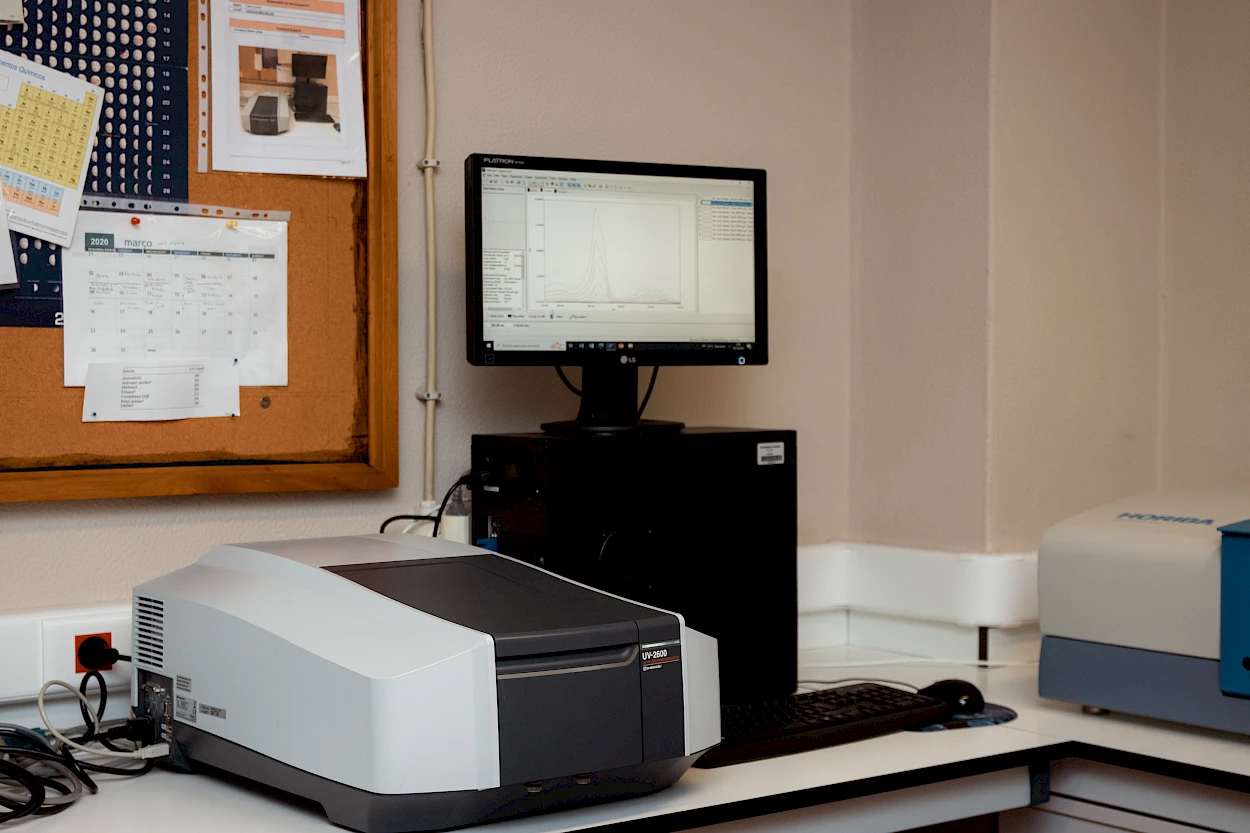
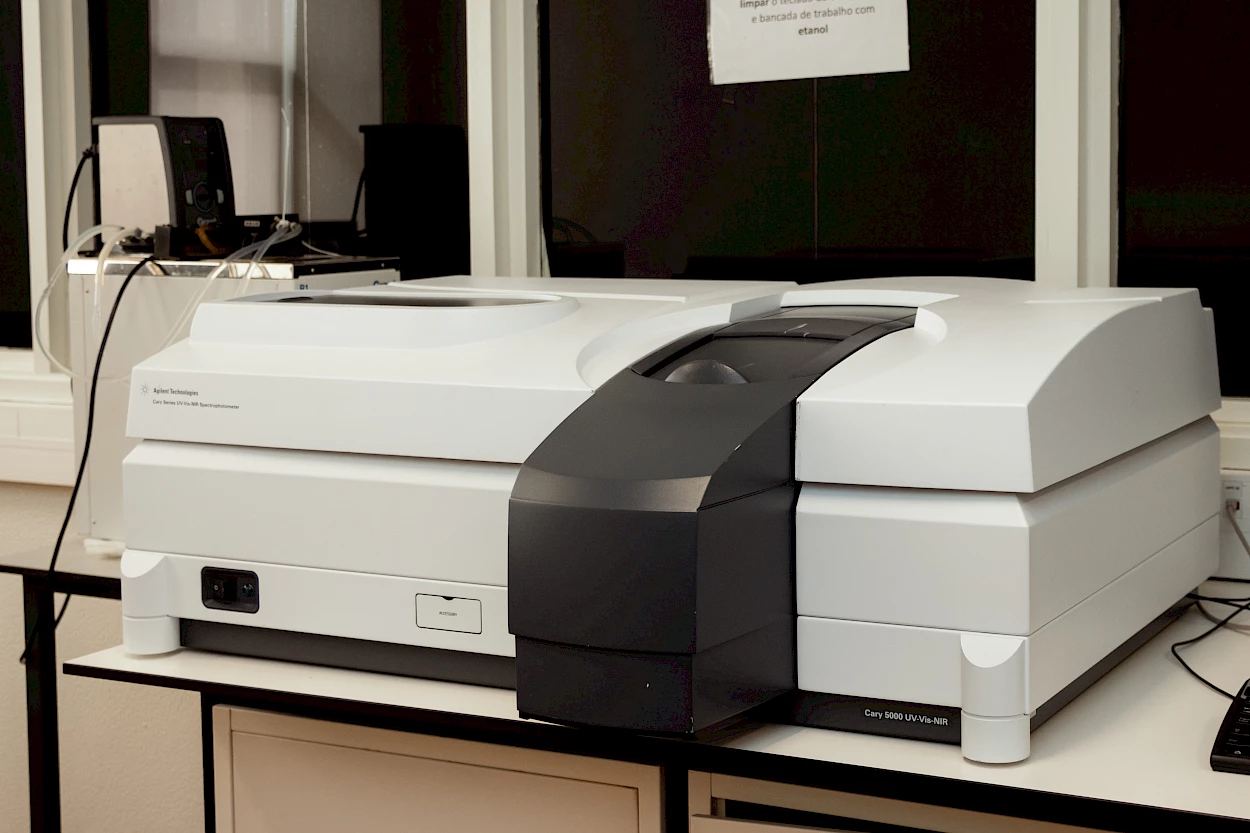
The following specific main equipments are available:
- Two fluorescence spectrophotometers (Horiba-Jobin-Yvon FL322 and Fluoromax 4) and phosphorimeter. Also available are numerous accessories such as specific cuvettes and integrating sphere for solid state fluorescence quantum yield determinations.
- Nanosecond time correlated single photon counting (with ca. 150 ps time resolution) with nanoLEDs (282 nm, 311 nm, 339 nm, 373 and 460 nm) as excitation source.
- Picosecond time correlated single photon counting (with ca. 3 ps time resolution). The excitation source consist of a picosecond mode-locked Ti:Sapphire Laser (Tsunami, Spectra Physics) pumped by a diode-pump YAG Laser (Millenia Pro- 10 s, Spectra Physics). Available excitation windows: 240-310 nm and 360- 470 nm). Alternatively, a PicoQuant picoled model LDH-P-C-450B with λexc= 451 nm can be used as excitation source. The detection system of the ps-TCSPC equipment includes a Hamamatsu microchannel plate photomultiplier (R3809U-50) with emission wavelength range from ~290 to 850 nm.
- Polarizers for fluorescence anisotropy (steady-state and time-resolved) studies are also available.
- Access to controlled low temperature experiments (from 300 K to 77 K) including absorption and fluorescence (steady-state and time-resolved), laser flash photolysis through an Oxford Instruments Optistat DN2 cryostat.
- HPLC-DAD
- Spin-coating and associated film making facilities.
Shared facilities
- Modified Spectrophotometer OLIS Cary-14 (UV-Vis-NIR; 200-2500 nm)
- Spectrophotometer UV-Vis. Shimadzu UV-2100
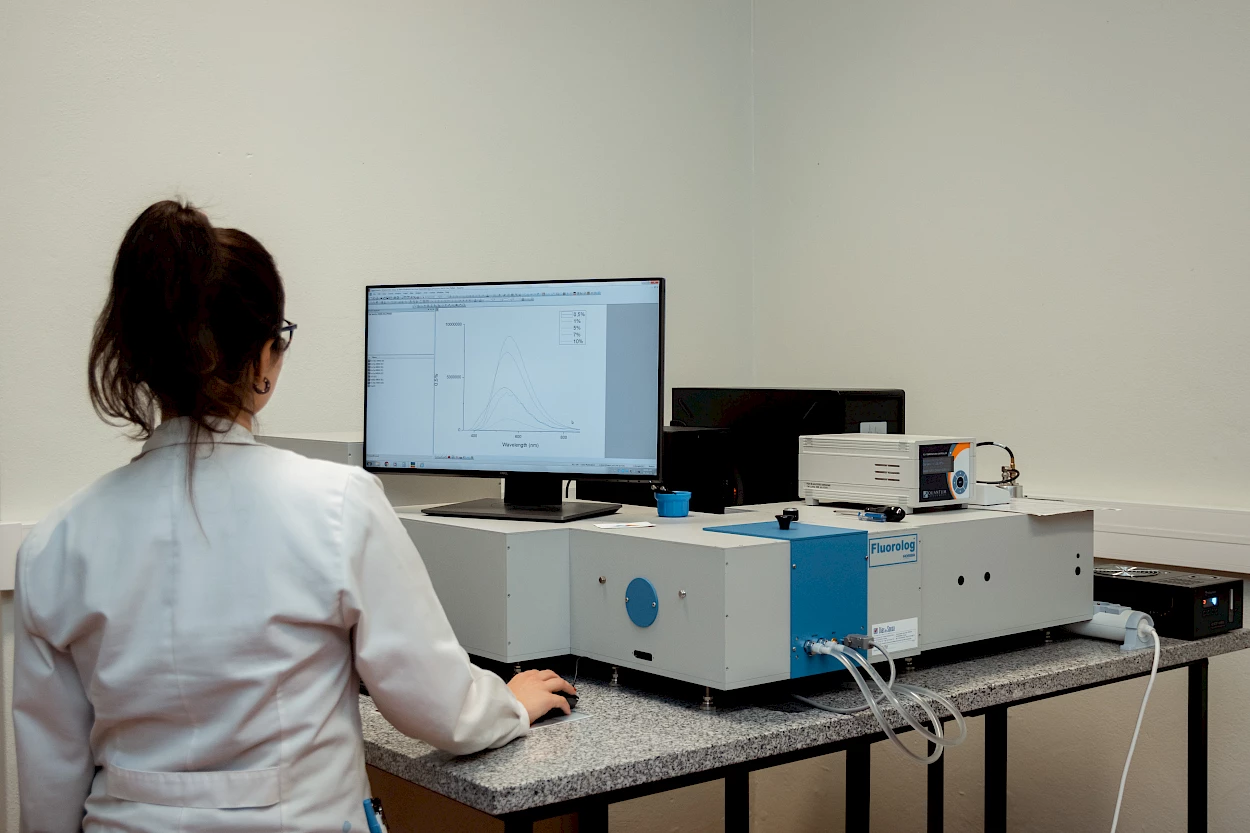
- Fluorimeter Horiba-Jobin-Yvon SPEX Fluorolog FL3-22 1999 (UV-Vis-NIR; 250-2000 nm) with integrating sphere accessory for quantum yield measurements
- Phosphorimeter SPEX 1934D3
- Fluorescence microscope
- Home made high pressure line and optical cells for supercritical fluid spectroscopy and synthesis
- Compact Refrigerated Circulator Julabo F30-C
- Photochemical Reactor Applied Photophysics RS-55
- Amersham Biosciences AKTApurifier for protein purification
- Desk top precision spin coating system, Model P6700, Speedline Technologies
- MilliQ Academic from Millipore
- Zone Refiner from Design Scientific, model Purifier 10, 50/60 Hz, 400 watt
- Rheometer Stress Tech Reologica with stress controlled and automatic gap settings
- Franz cells
- Screen printing for thin nanoparticle film production
- Controlled temperature oven
- Newport QE/IPCE Measurement Kit comprising a 300 W Xe arc light source, a CS260 monochromator, dual channel Merlin lock-in amplifier, current preamp, optical chopper, automated filter wheel and Si detector.
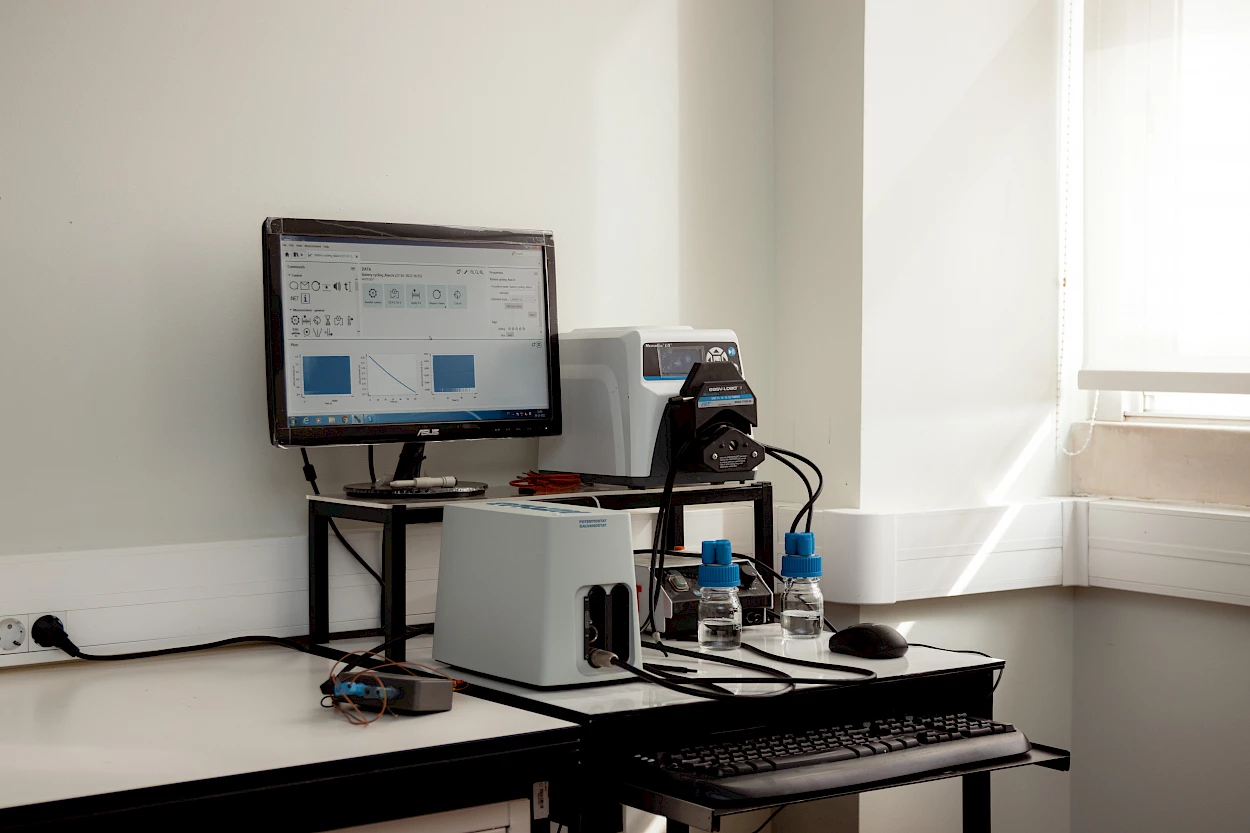
- Metrohm Autolab PGSTAT 10 electrochemical analyzer
- Keithley 2400 source meter (with four point probe for thin film resistivity measurements)
- Cell culture Laboratory
- 1200 square meters of lab space and offices