


About
The Centre for Classical and Humanistic Studies (CECH) is an R&D Unit specialising in Classical Studies, with an emphasis on the fields of Culture and Heritage.
What are our scientific areas?
Bringing together different areas from the Humanities and Arts and promoting dialogue between them, we advance both fundamental research and science applied to the needs of people, institutions, and non-academic bodies.
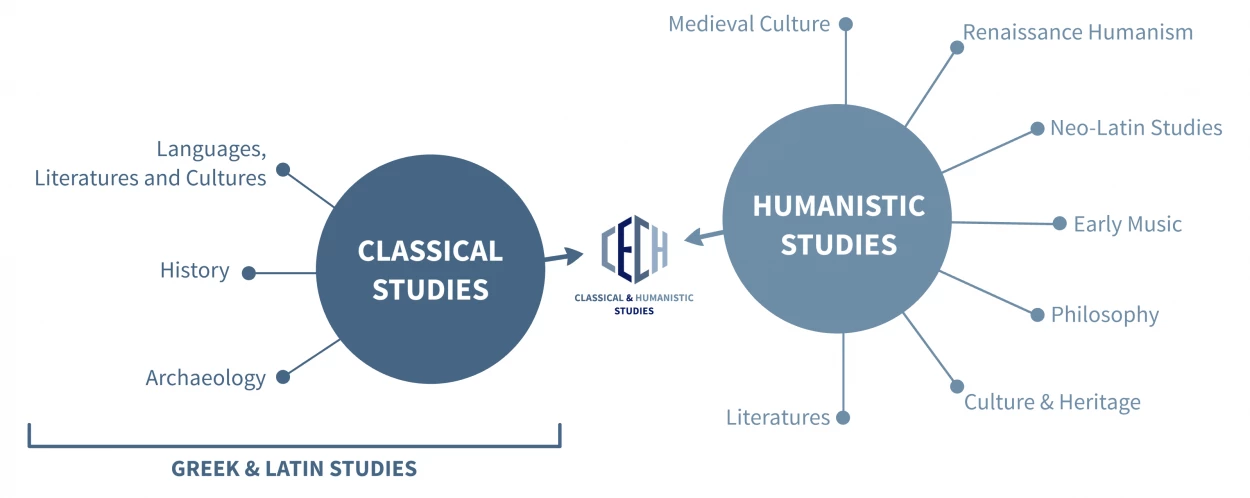
Classical Studies is our main scientific area (comprising Greek & Latin Studies), and it is organised into three main fields: Languages, Literatures and Cultures; History; and Archaeology.
Humanistic Studies, on the other hand, cover a vast array of fields whose chronologies extend to our present day: Medieval Culture; Renaissance Humanism; Neo-Latin Studies; Early Music; Philosophy; Culture and Heritage; and Literatures.
From the synergy between these comprehensive domains, our scientific profile emerges: Classical & Humanistic Studies.
What are our Main Objectives (MOs) and the United Nations Sustainable Development Goals (SDGs) to which we contribute?
Our strategy is humanistic, prioritising human values and sustainability. This approach clearly aligns with the five pillars of the 2030 Agenda: People, Planet, Prosperity, Peace, and Partnerships.
CECH’s 2025-2029 Research & Development Work Programme targets four Main Objectives, aligned with five United Nations Sustainable Development Goals.
MO1. To generate and promote leading-edge fundamental and applied research adhering to rigorous international standards via:
- Publications
- Organisation and participation in scientific events
- European networks and projects
- Database development for at-risk or underrepresented intangible heritages
- Fostering multilingualism in the production of European and global scientific, artistic, and technological culture

MO2. To produce advanced doctoral training and research, collaborating closely with educational bodies, cultural organisations, businesses, and public and private entities through:
- four high-quality PhD programmes in:
- Classical Studies
- Food Heritage: Cultures and Identities
- Art Studies - Early Music
- Philosophy
- applied PhD research in partnership with non-academic entities and in the context of EU projects.
 |
 |
 |
MO3. To support research careers across all stages, ensuring researchers’ happiness and well-being by:
- Promoting gender balance and equality of opportunities e
- Establishing career advisory and support services, a plan to attract and retain talent, and a Well-being Programme for Researchers.
 |
 |
 |
MO4. To conduct research that directly serves and engages civil society:
- Through inclusive outputs and dissemination activities targeting socially and economically disadvantaged groups
- By involving society in shaping the Unit’s societal agenda as envisaged by activities like the Coimbra Global Lectures, CECH’s Open Day, and CECH Roadshows for All.
|
|
|
FCT Funding
CECH was classified by FCT - Fundação para a Ciência e a Tecnologia, I.P., as Excellent, for the 2025-2029 evaluation period, within the project with the reference UID/00196/2025 and DOI identifier 10.54499/UID/00196/2025.

Research Ethics Committee of the University of Coimbra
CEIUC is an advisory body to the Rector, whose mission is to contribute to the observance of the principles of ethics and scientific integrity in scientific research activities carried out at the University of Coimbra (UC). It is responsible for ensuring the highest ethical standards, dignity and non-discrimination, observance of the principles of autonomy, responsibility, honesty, quality and scientific integrity, across all areas of knowledge, promoting intellectual freedom and transparent, fair and effective processes.
More information: www.uc.pt/ceiuc.
Internal Reporting Channel
The Centre for Classical and Humanistic Studies repudiates any manifestations that may constitute abuse of power, moral and sexual harassment, improper conduct, conflicts of interest, corruption and related infractions, discrimination, fraud, theft, and misuse of CECH resources. As a Research and Development Unit integrated in the University of Coimbra, it grants its researchers and technical staff the UC Internal Denouncement Channel: https://denuncia.uc.pt/