


ECORedox: Environmental Sustainable Functional Redox Organic Materials for Energy Storage
KEYWORDS: Energy Storage; Organic Redox Flow Batteries; Sustainable Technology; Tryptanthrin Derivatives.
Energy storage is an emerging sector in constant development that is reshaping the renewable energy market. The development of an environmentally friendly route to capture and store clean energy is needed to fulfill the world needs in a sustainable way. The reduction of energy consumption and the development of efficient routes for solar light capture and storage are key challenges.
Redox Flow Batteries (RFB) are frequently described as affordable, reliable (with extremely long charge/discharge life cycles) and eco-friendly, depending on the materials used, electrochemical energy storage devices. This allows to use the energy stored whenever is necessary. This is particularly important in cloudy days or during the night where the sunlight is absent.
This project aims to develop the efficiency of aqueous all-organic RFB, with new organic active materials, to make the technology competitive and sustainable. Conventional RFB, already in use nowadays, are based on all-vanadium materials. Despite the advantages of this implemented technology, it uses toxic and pollutant inorganic materials (with a high cost and toxicity associated to vanadium), whose substitution for organic (environmentally friendly) active materials is a competitive challenge.
Electrolytes can be considered as central components in redox flow batteries (RFBs) with a determinant role on battery performance. This project involves a new class of water-soluble tryptanthrin derivatives and their use as components of RFBs. In particular, the identification and characterization of sulfonic acid, sulfonamide, ester and amine derivatives of tryptanthrin with redox properties adequate for its use as electrolytes in inorganic/organic or all organic aqueous redox flow batteries.
The project also involves the optimization of the RFB set-up to achieve high efficiency, with reproducible charge-discharge cycles and efficiencies stabilized during at least 250 working cycles. We also aim to test new membranes to replace the conventional proton exchange Nafion membrane.
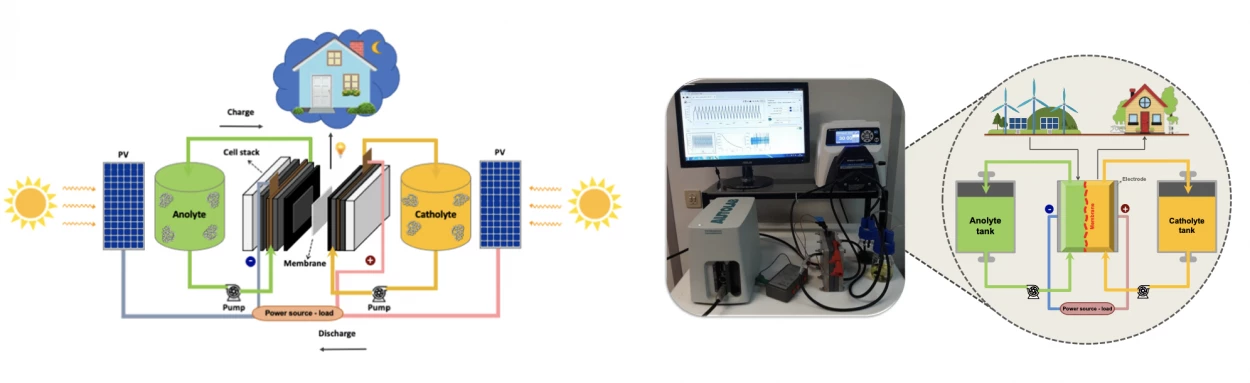
Conversion of solar radiation into electrochemical energy with a redox flow battery (RFB) replacing vanadium (inorganic) with all-organic active compounds | Fully organic solar powered redox flow battery prototype and proof of concept from University of Coimbra
Advantages |
| Clean energy-related applications and battery technologies. |
| Ecofriendly chemical and electrochemically stable redox for sustainable energy storage. |
| Development of organic active materials whose chemical hazard is strongly decreased. |
| Synthesis of organic active materials for an all-organic RFB with synthetic methodologies using Green Chemistry principles. |
| To use low-cost membranes with optimization of the overall cell setup. |
| RFB can be size-modulated to the energetic needs of a building, factory, etc. |
Applications |
|
Storage of energy from an eco-friendly chemical process.
|
|
RFB can be coupled with photovoltaic systems to collect solar energy that can be further used to produce electrical energy. |
| All-organic redox flow batteries can be a viable alternative to the established vanadium-based redox flow batteries (VRFB). |

Este conteúdo é reproduzido a partir de uma fonte externa e não está disponível porque os cookies não foram aceites.
Eis o que pode fazer:
STAGE OF DEVELOPMENT: TRL 3
IPR LEGAL STATUS: Patent Pending in Europe (Process number: EP4211137) and USA (Process number: 18026275), claiming PCT/IB2021/058195.
OWNERSHIP: The rights to the technology are held by the University of Coimbra.
COLLABORATION SOUGHT:
- Technology Scale-up (development support) from laboratory to pre-industrial scale;
- In-house test-bed (in industrial environment) and proof-of-concept testing in a familiar house;
- Technical engineering support and technology adaptation/orientation up-to-market.