


Aberrant Crypt Foci and Human Colorectal Polyps: mathematical modelling and endoscopic image processing
| | |
Problem Description
Colorectal cancer is one of the most frequent malignant tumors in the world. In Portugal, in 2003, it was ranked first in terms of mortality among the five major cancer types (lung, breast, colon, stomach and prostate). Unlike most other malignancies, it is possible to prevent colorectal cancer. This is due to the long period of time elapsed between the appearance of an adenoma (a benign epithelial tumor) and the eclosion of the carcinoma, which allows the detection and removal of the benign lesion. In this context, Aberrant Crypt Foci (ACF) may have a crucial and determinant role. These are clusters of aberrant (deviant from normal) crypts (small pits, which are compartments of cells, in the colon epithelium) that are thought to be the precursors of colorectal cancer. In fact, according to endoscopic studies and animals' experiments, ACF precede the eclosion of adenomas. Thus, if this claim is proved, it means that the ACF must be considered part of the adenoma-carcinoma sequence, and consequently, they should be used not only for diagnosis purposes and the stratification of the risk, but for chemopreventive studies together with pharmacology agents.
Modelling & Computational Challenges
The scope of this project is twofold:
- To establish realistic mathematical models to simulate the behavior and dynamics of ACF, using the available biological and medical data.
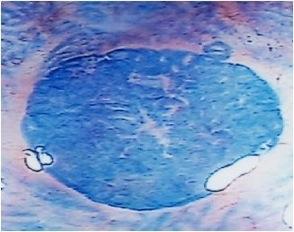
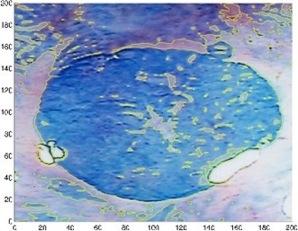
- To develop a computorized image analysis in order to identify, quantify and qualify the ACF captured in vivo by endoscopy (remark: the endoscopic qualification of an ACF is expressed in terms of the number of crypts' holes and the patterns of these holes' shapes).
This research will be a contribution to biomathematics and medical imaging, useful to assist doctors, with respect to the diagnosis, the prevention and the treatment of colorectal cancer.
Research at LCM
For the modelling part, our goal is to use ordinary differential equations (for example, logistic-type equations) and partial differential equations (for example, conservation laws) to simulate the dynamics of ACF's population. We also intend to use similar models to study four populations of cells (proliferating and apoptotic) in the ACF's population and in the normal colon mucosa. The mathematical analysis of these models involves the study of the existence and possible uniqueness of solutions, and their analytical or numerical solutions. In addition, we will use available medical data for ACF, concerning four classes of patients grouped according to the following different characteristics: adenomatous polyps patients, non-adenomatous polyps patients, carcinoma patients and without lesions patients (these medical data include information about the influence of age, sex, smoking and alcoholic habits, and familiar history, which will be used as well).
For the image processing part our aim is to develop a computerized and fast algorithm to assess the ACF patterns images captured in vivo by endoscopy (we emphasize that the main advantage of such an algorithm is to reduce the huge amount of time required by a well trained doctor to analyze the endoscopic images). The objective is to segment the boundary of each ACF, as well as, the crypts' holes in its interior (the total ACF number and each ACF dimension, the latter expressed in terms of the number of crypts's holes and the patterns of these holes' shapes, are most relevant for medical analysis). In particular, PDE (partial differential equation) based image processing methods will be applied.
 |  |
 |  |
| | |
| Two medical images (left column) and correspondent segmentations (right column, yellow contours). | |
Papers & Reports
[1] I. N. Figueiredo, P. N. Figueiredo, N. Almeida, M. C. Leitão, O. Ghattas, G. Stadler, Endoscopic detection of human colonic aberrant crypt foci using mathematical methods, Endoscopy 2008, 40 (Suppl 1) A 189
[2] Isabel N. Figueiredo, Pedro N. Figueiredo, Carlos Leal and José Miguel Urbano, A mathematical model for a comprehensive approach to the dynamics of human colonic aberrant crypt foci, Preprint 08-01 of the Department of Mathematics, University of Coimbra, 2008
[3] Isabel N. Figueiredo, Carlos Leal, Tommaso Leonori, Giuseppe Romanazzi, Pedro N. Figueiredo and M. Manuel Donato, A coupled convection-diffusion level set model for tracking epithelial cells in colonic crypts, Procedia Computer Science, 1, 1 (2010) 955-963
[4] I. N. Figueiredo, P. N. Figueiredo, G. Stadler, O. Ghattas and A. Araújo: Variational image segmentation for endoscopic human colonic aberrant crypt foci, IEEE Transactions on Medical Imaging, 29, 4 (2010) 998-1011
[5] Pedro N. Figueiredo, Isabel N. Figueiredo, Surya Prasath and Richard Tsai, Automatic polyp detection in PillCam COLON 2 capsule images and videos - preliminary feasibility report, Diagnostic and Therapeutic Endoscopy, vol. 2011, Article ID 182435, 7 pages, 2011
[6] Isabel N. Figueiredo, Carlos Leal, Giuseppe Romanazzi, Bjorn Engquist, Pedro N. Figueiredo, A convection-diffusion-shape model for aberrant colonic crypt morphogenesis, Computing and Visualization in Science, 14, 4 (2011) 157-166
[7] Isabel N. Figueiredo, Pedro Figueiredo, Nuno Almeida: Image-driven parameter estimation in absorption-diffusion models of chromoscopy, SIAM Journal on Imaging Sciences, 4, 3 (2011) 884-904
[8] Isabel N. Figueiredo, Carlos Leal: Physiologic parameter estimation using inverse problems, Preprint 12-06 of the Department of Mathematics, University of Coimbra, 2012
[9] Isabel N. Figueiredo, Juan Carlos Moreno, V. B. Surya Prasath and Pedro N. Figueiredo: A Segmentation Model and Application to Endoscopic Images, In Lecture Notes in Computer Science (Springer), Volume 7325, Image Analysis and Recognition (eds.: A. Campilho and M. Kamel), pp. 164-171, June 2012., Pages 164-171, 2012
[10] I. N. Figueiredo, J. C. Moreno, V. B. S. Prasath: Texture Image Segmentation with Smooth Gradients and Local Information, Computational Modeling of Objects Presented in Images: Fundamentals, Methods and Applications III, In Proceedings of the International Symposium CompIMAGE 2012, Rome, Italy, September 5-7, 2012. CRC Press, Taylor & Francis Group (eds.: Paolo Di Giamberardino & Daniela Iacoviello, R.M. Natal Jorge & João Manuel Tavares), pp. 115-119, 2012
[10] Isabel N. Figueiredo and Carlos Leal, Physiologic Parameter Estimation Using Inverse Problems. SIAM Journal on Applied Mathematics 73(3), 1164–1182, 2013
[11] Isabel N. Figueiredo, Sunil Kumar and Pedro N. Figueiredo, Computer-assisted bleeding detection in wireless capsule endoscopy images. Computer Methods in Biomechanics and Biomedical Engineering: Imaging & Visualization, 2013
[12] Isabel N. Figueiredo, Giuseppe Romanazzi, Carlos Leal and Bjorn Engquist, A Multiscale Model for Aberrant Crypt Foci. Procedia Computer Science 18, 1026–1035, 2013
[13] Marco Martins, Gabriel Falcão and Isabel N. Figueiredo, Fast Aberrant Crypt Foci on the GPU. In Proceedings of the 38th International Conference on Acoustics, Speech, and Signal Processing (ICASSP 2013), IEEE Signal Processing Society, 2013
Software
- Image segmentation MATLAB code - incorporates the algorithm of T.F. Chan and L.A. Vese, Active contour without edges, IEEE Trans. Image Processing, 10(2) (2001) 266-277, and the toolbox by Ian M. Mitchell, A Toolbox of Level Set Methods version 1.0, 2004.
Project Team
- Isabel M. Narra de Figueiredo (LCM/CMUC, Project’s Principal Investigator)
- Carlos M. Franco Leal (LCM/CMUC)
- Giuseppe Romanazzi (LCM/CMUC)
- Surya Prasath (LCM/CMUC?)
- Juan C. Moreno Briceño (LCM/CMUC)
- Pedro M. Narra de Figueiredo (Faculty of Medicine, University of Coimbra)
- Maria Manuel R. S. Romão Donato (Faculty of Medicine, University of Coimbra)
- Nuno Miguel Peres de Almeida (HUC - University Hospital of Coimbra)
- Sandra M. Fernandes Lopes (HUC - University Hospital of Coimbra)
- João Manuel Tavares (FEUP- Faculty of Engineering, University of Porto)
- Zhen Ma (FEUP- Faculty of Engineering, University of Porto)
- Ilda Marisa de Sá Reis (FEUP - Faculty of Engineering, University of Porto)
- Mário Alexandre Teles de Figueiredo (IT and IST - Technical University of Lisbon)
- José Manuel Bioucas Dias (IT and IST - Technical University of Lisbon)
- Chandrajit Bajaj (ICES, University of Texas at Austin, USA)
- Bjorn Engquist (ICES, University of Texas at Austin, USA)
- Omar Ghattas (ICES, University of Texas at Austin, USA)
- Georg Stadler (ICES, University of Texas at Austin, USA)
- Yen-Hsi Richard Tsai (ICES, University of Texas at Austin, USA)
Project Reference
FCT Research Project - UTAustin/MAT/0009/2008


