


Mathematical Analysis of Piezoelectric Problems
| | | |
Problem Description
Piezoelectricity can be defined as an interaction between two phenomena: the direct piezoelectric effect (a mechanical deformation generates an electric field in the material) and the inverse piezoelectric effect (the application to the material of an electric field or of a potential difference generates a deformation), cf. T. Ikeda, Fundamentals of Piezoelectricity, Oxford University Press, Oxford, 1990. Therefore, a single piezoelectric device is both an actuator and a sensor, and consequently, piezoelectric materials belong to a class of smart or intelligent materials, that are very important in many applications as, for example, biomechanics, biomedicine, structural mechanics, etc.
Modelling & Computational Challenges
The scope of this project is essentially to acquire a better mathematical knowledge of some particular piezoelectric models, as adaptive rod models and composite laminated plate models. This research project will lead to a better understanding of the mechanical and electric behavior of these problems and, consequently, to an improvement of real-life applications.
Research at LCM
Research will be developed along the following lines:
Asymptotic and variational methods for the mathematical formulation, and related questions of existence and regularity of solutions.
Discretization schemes, using finite element and finite difference methods.
Analysis of error estimates.
Algorithms to solve the discrete problems, such as deterministic optimization algorithms and evolutionary algorithms.
Code development (envolving both finite elements and optimization).
| | | |
 |  |  |
| | | |
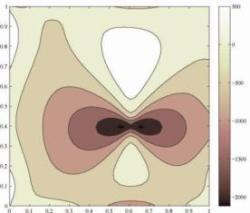
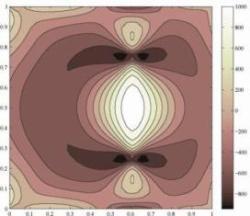
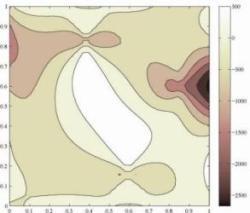
| Contour plots of the electric potential for a square piezoelectric plate in frictional contact with a rigid obstacle (three different obstacles). | ||
Papers & Reports
- [1] I. Figueiredo and G. Stadler, Frictional contact of an anisotropic piezoelectric plate, Preprint 07-16 of the Department of Mathematics, University of Coimbra, 2007
- [2] Georg Stadler, Elliptic optimal control problems with L1-control cost and applications for the placement of control devices, Preprint 06-42 of the Department of Mathematics, University of Coimbra, 2006
- [3] L. Costa, I. Figueiredo, R. Leal, P. Oliveira, G. Stadler, Modeling and numerical study of actuator and sensor effects for a laminated piezoelectric plate, Computers and Structures, 85(7-8) (2007) 385-403
- [4] Isabel N. Figueiredo and Georg Stadler, Optimal control of piezoelectric anisotropic plates, in CD-ROM Proceedings of the III European Conference on Computational Mechanics: Solids, Structures and Coupled Problems in Engineering, C. A. Mota Soares et al. (eds.), Lisbon, Portugal, 5-8 June 2006
- [5] Isabel M. N. Figueiredo and Carlos M. F. Leal, A generalized piezoelectric Bernoulli-Navier anisotropic rod model, Journal of Elasticity, 85(2) (2006) 85-106
- [6] L. Costa, P. Oliveira, I.N. Figueiredo and R. Leal, Actuator effect of a piezoelectric anisotropic plate model, Mechanics of Advanced Materials and Structures, 13(5) (2006) 403-417.
- [7] Isabel N. Figueiredo, Approximation of bone remodeling models, Journal de Mathématiques Pures et Appliquées Vol. 84, 12 (2005) 1794-1812
- [8] Isabel N. Figueiredo; Carlos F. Leal and Cecília S. Pinto, Shape analysis of an adaptive elastic rod model, SIAM Journal on Applied Mathematics 66(1) (2005) 153-173
- [9] Isabel N. Figueiredo; Carlos F. Leal and Cecília S. Pinto, Conical differentiability for bone remodeling contact rod models, ESAIM: Control, Optimisation and Calculus of Variations, 11(3) (2005) 382-400
- [10] Isabel N. Figueiredo and Carlos F. Leal, A piezoelectric anisotropic plate model, Asymptotic Analysis, 44(3-4) (2005) 327-346
Software
- [1] Patches - Finite Element Code for Elastic Plates with Piezoelectric Patches (Matlab code for the software COMSOL MULTIPHYSICS 3.3) - available under request.
- [2] Lampiezo.m - Finite Element Code for a Laminated Piezoelectric Plate (Matlab code for the MATLAB Toolbox CALFEM) - available under request.
- [3] Piezo.m - Finite Element Code for a Piezoelectric Plate (MATLAB code for the Matlab Toolbox CALFEM) - available under request.
Project Team
- Isabel Maria Narra de Figueiredo, LCM/CMUC
- Carlos M. Franco Leal, LCM/CMUC
- Pedro N. F. P. Oliveira, Department of Production and Systems, University of Minho
- Rogério A. C. P. Leal, Department of Mechanical Engineering, University of Coimbra
- Georg Stadler, ICES, University of Texas at Austin, USA
- José António Carvalho, Department of Mathematics, University of Coimbra
- Lino Costa, Department of Production and Systems, University of Minho
- Cecília S. Pinto, Department of Mathematics, IPV
- Luis M. F. Roseiro, Department of Mechanical Engineering, ISEC
- Urbano M. O. Ramos, Department of Mechanical Engineering, ISEC
Project Reference
FCT Research Project - POCI/MAT/59502/2004


