


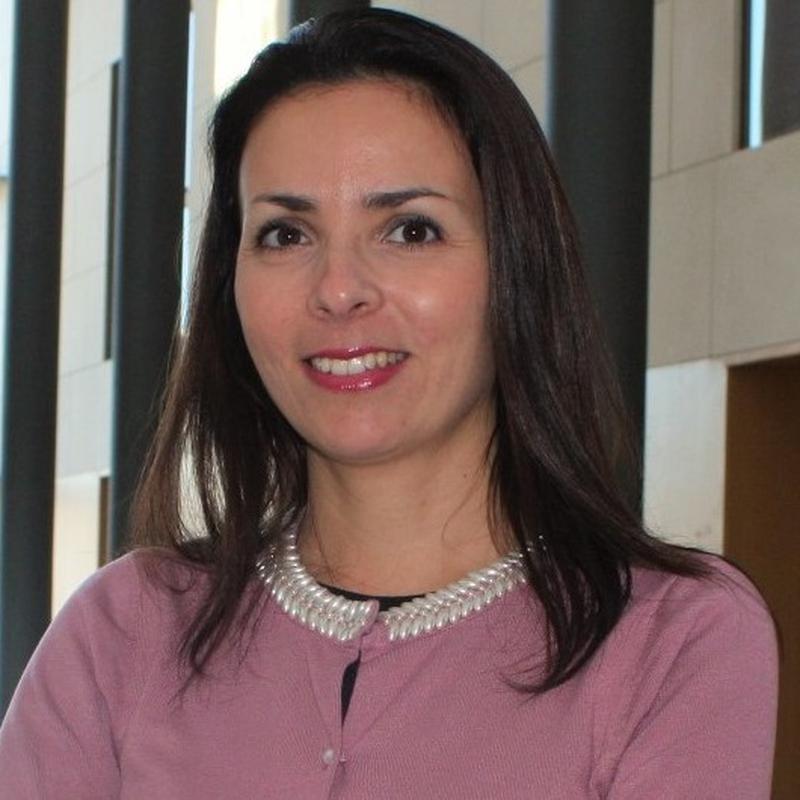
Isabel Dimas Membro Pleno
Isabel Cristina Dórdio Dimas é licenciada (2003) e doutorada (2007) em Psicologia das Organizações pela Universidade de Coimbra, tendo apresentado uma tese de doutoramento na área da gestão de conflitos nas organizações. É Professora no Ensino Superior desde 2003 sendo, atualmente, Professora Auxiliar na Faculdade de Economia da Universidade de Coimbra e membro do CeBER.
Os seus interesses de investigação centram-se na área do Comportamento Organizacional e da Gestão de Recursos Humanos. Em particular, tem estudado a gestão e o desenvolvimento de equipas de trabalho, os processos relacionados com a liderança de pessoas e de grupos, os conflitos e a negociação nas organizações e, mais recentemente, a gestão das emoções e a gestão da idade nas organizações.
As suas publicações incluem algumas dezenas de artigos publicados em revistas nacionais e internacionais (e.g., Negotiation and Conflict Management Research, Team Performance Management, Computers and Human Behavior, The Learning Organization, Journal of Psychology, Journal of Work and Organizational Psychology), bem como capítulos de livro nacionais e internacionais. É ainda (co)autora de um livro de edição nacional na área da gestão de equipas.
Orientação de doutorandos
The Impact of Corporate Social Responsibility on Employee´s Performance: The role of individual virtues and national cultural(2022)
Sara Marina Oliveira Ramos
Orientação

Technological platforms, risk, and customer service(Em curso)
Omar Dias
Orientação

Individual and team involvement, performance and well-being in times of crisis(Em curso)
Analice Valdman
Orientação

The antecedents of radical and incremental creativity in employees and teams(2024)
Avilton Júnior
Orientação
Exploring leaders´ trust in subordinates in the workplace(2024)
Karma Lhaden
Orientação
Publicações
Will trust move mountains? Fostering radical ideas in public organizations. Journal of Public Administration Research and Theory.(2024)

When affective commitment leads to viability: The role of trust as a mediator and virtuality as a moderator. European Management Journal.(2024)

Having Each Other's Back: The Mediating Role of Supportive Behaviours in the Relationship Between Team Autonomy and Team Effectiveness. Organizacija, 57, 87-98.(2024)
Trust and Conflict in Online Groups with Faultlines: Results of an Intervention to Improve Emotion Regulation. The Journal for Specialists in Group Work, 49, 103-119.(2024)
Can virtuality be protective of team trust? Conflict and effectiveness in hybrid teams. Behaviour and Information Technology, 42, 851 – 868.(2023)
What drives team learning: core conditions and paths. Journal of Workplace Learning, 35, 146 – 163.(2023)
Paths to Team Success: A Configurational Analysis of Team Effectiveness. Human Performance, 36, 155-179.(2023)

Green Human Resource Management: A Bibliometric Analysis. Administrative Sciences, 12, 95.(2022)
Dynamics of Team Learning Behaviours: The Effect of Time and Team Culture. Behavioral Sciences, 12, 449.(2022)
Innovation in Teams: The Role of Psychological Capital and Team Learning. The Journal of Psychology, 156, 133-146.(2022)
Guest editorial. The Learning Organization, 29, 1-5.(2022)
Can virtuality be protective of team trust? Conflict and effectiveness in hybrid teams. Behaviour & Information Technology, 1-18.(2022)
How Life Transitions Influence People's Use of the Internet: A Clustering Approach. Computational Science and Its Applications – ICCSA 2022 Workshops. ICCSA 2022. Lecture Notes in Computer Science, (pp 97-112).(2022)

How Life Transitions Influence People's Use of the Internet: A Clustering Approach. 2nd International Conference on Computational Science and Its Applications , ICCSA 2022. 97-112.(2022)
Maximizing Learning Through Cohesion: Contributions From a Nonlinear Approach. Small Group Research, 52, 162–188.(2021)
Comunicação interna em contexto de crise: Adaptação de um instrumento de avaliação. X Conferência Internacional de Investigação e Intervenção em RH.(2021)
Building Innovative Teams: Exploring the Positive Contribute of Emotions Expression and Affective Commitment. Frontiers in Psychology, 12.(2021)
PLS Visualization Using Biplots: An Application to Team Effectiveness. Lecture Notes in Computer Science (including subseries Lecture Notes in Artificial Intelligence and Lecture Notes in Bioinformatics). 214-230.(2020)
The journey of team learning since “The Fifth Discipline”. The Learning Organization, 27, 42-53.(2020)
How does the Leader's Centrality affect Team Performance Assessment? Testing the Role of Leader's Satisfaction. The Spanish Journal of Psychology, 23, e38.(2020)
On the mediating role of team psychological safety in the relationship between transformational leadership and team process improvement. In: da Silva, Patrícia Pereira, Jorge, Susana, Sá, Patrícia Moura e (Ed.), Emerging Topics in Management Studies, Coimbra: Imprensa da Universidade de Coimbra.(2020)


Grupos nas organizações: funcionamento e eficácia. In: Caetano, A, Neves, J. G., Ferreira, J.M. C (Ed.), Psicossociologia das Organizações, (pp 215- 250). Edições Sílabo.(2020)
A Nonlinear Dynamical System Perspective on Team Learning: The Role of Team Culture and Social Cohesion. In: Gervasi, O. (Ed.), ICCSA 2019, Lecture Notes in Computer Science, Vol. 11621. 38-49. Springer.(2019)
A Cusp Catastrophe Model for Satisfaction, Conflict, and Conflict Management in Teams. ICCSA 2018: Computational Science and Its Applications – ICCSA 2018. 335-350. Springer.(2018)
A neural network model for team viability. ICCSA 2017: Computational Science and Its Applications Lecture Notes in Computer Science. 560-573.(2017)
A nonlinear multicriteria model for team effectiveness. In: Gervasi, O., Murgante, B., Misra, S., Rocha, A.M.A.C., Torre, C.M., Taniar, D., Apduhan, B.O., Stankova, E., Wang, S. (Ed.), Proceedings of the 16th International Conference on Computational Science and Its Applications, ICCSA 2016. 595-609. Springer International Publishing.(2016)